Lifestyle
AI and Step Work: A New Tool for an Old Spiritual Practice
November 25, 2026
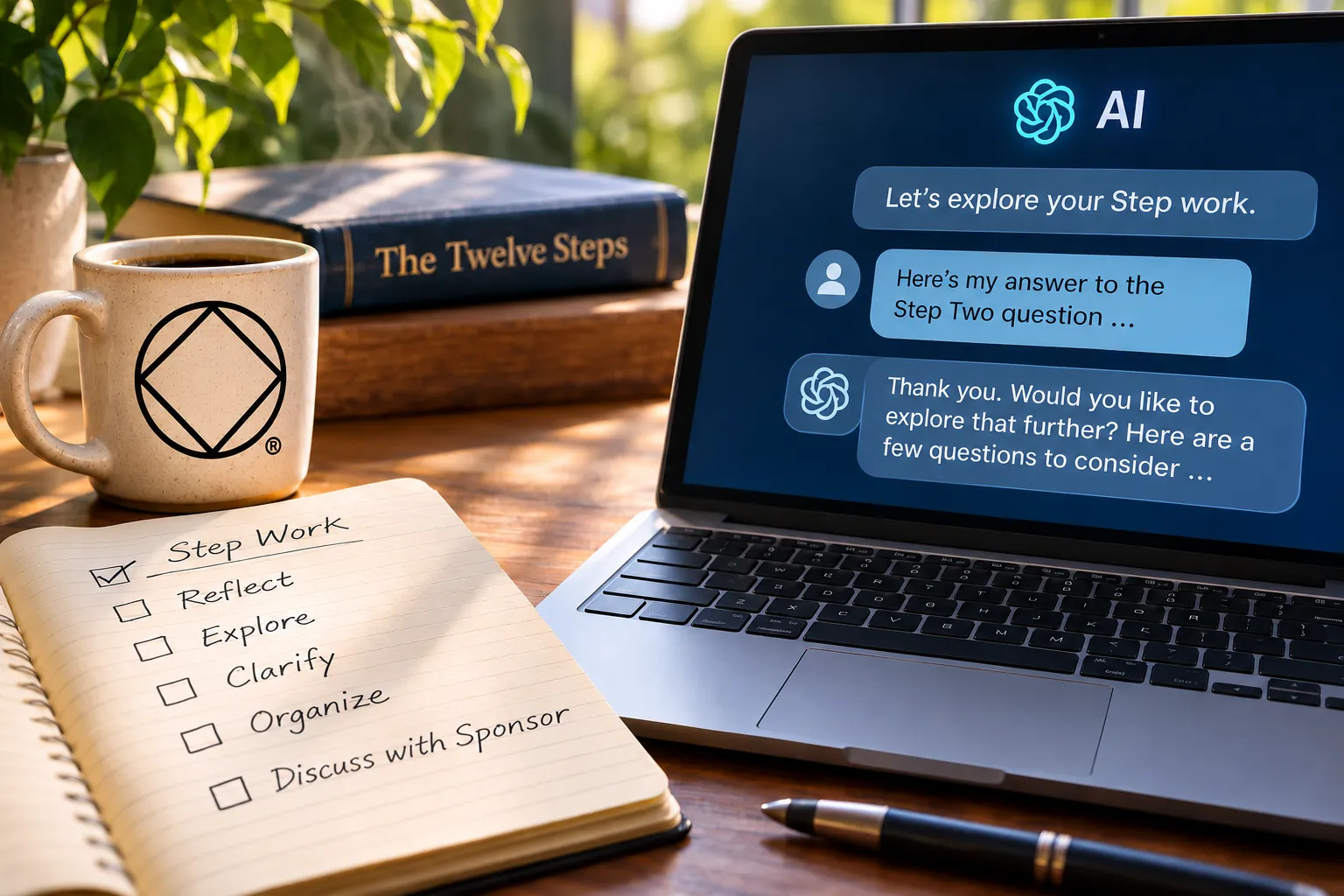
Using artificial intelligence to deepen reflection, reduce barriers, and participate more fully in recovery.
One of the most significant technological changes in Twelve Step recovery occurred during the COVID-19 pandemic. When we could no longer gather in person, platforms like Zoom let people continue attending meetings, maintain relationships, and participate in their recovery communities.
Technology did not replace recovery. It gave us another way to participate.
Artificial intelligence may represent another significant development in how we practice recovery, particularly when it comes to working the Twelve Steps.
Reducing the Friction
Many people have good intentions about working the steps but struggle to translate those intentions into reliable behavior.
Some people find writing difficult. Others struggle to organize their thoughts, maintain their attention, or get started. Some can talk for thirty minutes about their experiences but struggle to write a single paragraph about them.
Writing difficulty can become an obstacle to self-examination.
Artificial intelligence, particularly when combined with voice dictation, can reduce some of that friction. Instead of focusing on typing, spelling, grammar, and sentence construction, we can devote more attention to thinking, remembering, reflecting, and answering questions honestly.
The technology can help us capture our thoughts as they occur.
From Writing to Dialogue
One of the most interesting possibilities of using AI for step work is that it allows us to engage in a dialogue.
Rather than simply reading a question and writing an answer, we can speak our answers aloud and invite AI to ask additional questions.
For example, while working on the First Step, a person might be exploring what powerlessness means in their life. Their initial answer might be brief or limited to their experiences with substance use.
Through additional questions, they might begin to examine their relationship with control, their attempts to manage other people's behavior, their resistance to accepting reality, or their difficulty following through on good intentions.
While working on the Second Step, a person might begin exploring what it means to come to believe, what constitutes a power greater than themselves, or what restoration to sanity might look like in everyday life.
The purpose is not for AI to supply the answers. The purpose is to help us explore our own answers more thoroughly.
Sometimes we don't discover what we think until we start talking about it.
How to Get Started
You do not need extensive knowledge of artificial intelligence to begin. A smartphone, tablet, or computer with access to an AI platform that supports voice dictation is sufficient.
You might begin by giving the AI the following instructions:
I am working on my Twelve Step recovery. I will provide you with a step-work question and my answer. I do not want you to answer the question for me. I want you to help me explore my answer by asking thoughtful follow-up questions. Ask me one question at a time and allow me to respond before moving forward. Help me recognize patterns, examine my assumptions, and clarify my thinking. Do not assume that everything I say is correct. When I am finished, help me organize my responses into a summary that I can review and discuss with my sponsor.
Then enter the step-by-step question you are working on and begin answering it in your own words.
You can stop, reconsider an answer, introduce another experience, disagree with the AI, or return to an earlier question.
No need to rush through the process.
When you have finished, you can ask the AI to summarize your reflections while preserving your meaning and your voice. Read the summary carefully, correct anything that does not accurately represent your experience, and bring it to your sponsor.
AI Is Not a Sponsor
This technology has important limitations.
Artificial intelligence does not have lived recovery experience. It does not possess spiritual wisdom in the human sense, and it cannot take responsibility for our recovery. It can misunderstand us, provide inaccurate information, reinforce mistaken assumptions, or produce convincing explanations that are not necessarily true.
It cannot replace the experience of sitting with another human being who has struggled, recovered, and learned something about living.
The relationships we develop through recovery are essential. Sponsorship, meetings, fellowship, service, and the collective experience of people in recovery remain central to the process.
AI can help us prepare for those relationships and conversations. It should not replace them.
Protecting Our Anonymity and Privacy
Step work often involves highly personal information. Before using an AI platform, review its privacy settings and how it handles conversations.
Avoid including identifying information about other people. Names, addresses, meeting locations, and unnecessary personal details can generally be omitted without compromising the quality of your reflection.
Consider using initials, general descriptions, or anonymous examples. Remember that a conversation with an AI platform does not necessarily carry the same confidentiality protections as a conversation with a healthcare professional.
We have a responsibility to protect not only our own privacy but also others' anonymity.
The Spiritual Work Remains Ours
Recovery requires honesty, open-mindedness, willingness, courage, faith, humility, and practice.
No technological advancement relieves us of that responsibility.
Technology can make certain aspects of the process more accessible. It can help us become more curious about our experiences, recognize patterns in our behavior, articulate difficult feelings, and prepare for meaningful conversations with others.
It can help us spend less time struggling with the mechanics of writing and more time examining the lives we are living.
The objective of step work is not simply to produce a collection of well-written answers. It is to become more conscious of ourselves, our relationships, our behavior, and our possibilities for living differently.
Artificial intelligence may help us engage in that process, but the living, learning, and changing remain our responsibility.
Like Zoom, AI offers us another way to participate in recovery. What we make of that opportunity depends on how we choose to use it.
This article presents an independent perspective on the use of technology in recovery. It does not represent the official position or endorsement of any Twelve Step fellowship.
 GC
Gerald B. Chambers, LMFT #100367
Licensed Marriage and Family Therapist specializing in addiction, domestic violence, and relationships. Serving California clients online.
About Gerald →