Emotional Patterns
Is It Helping You Feel Better, or Helping You Move Forward?
November 10, 2026
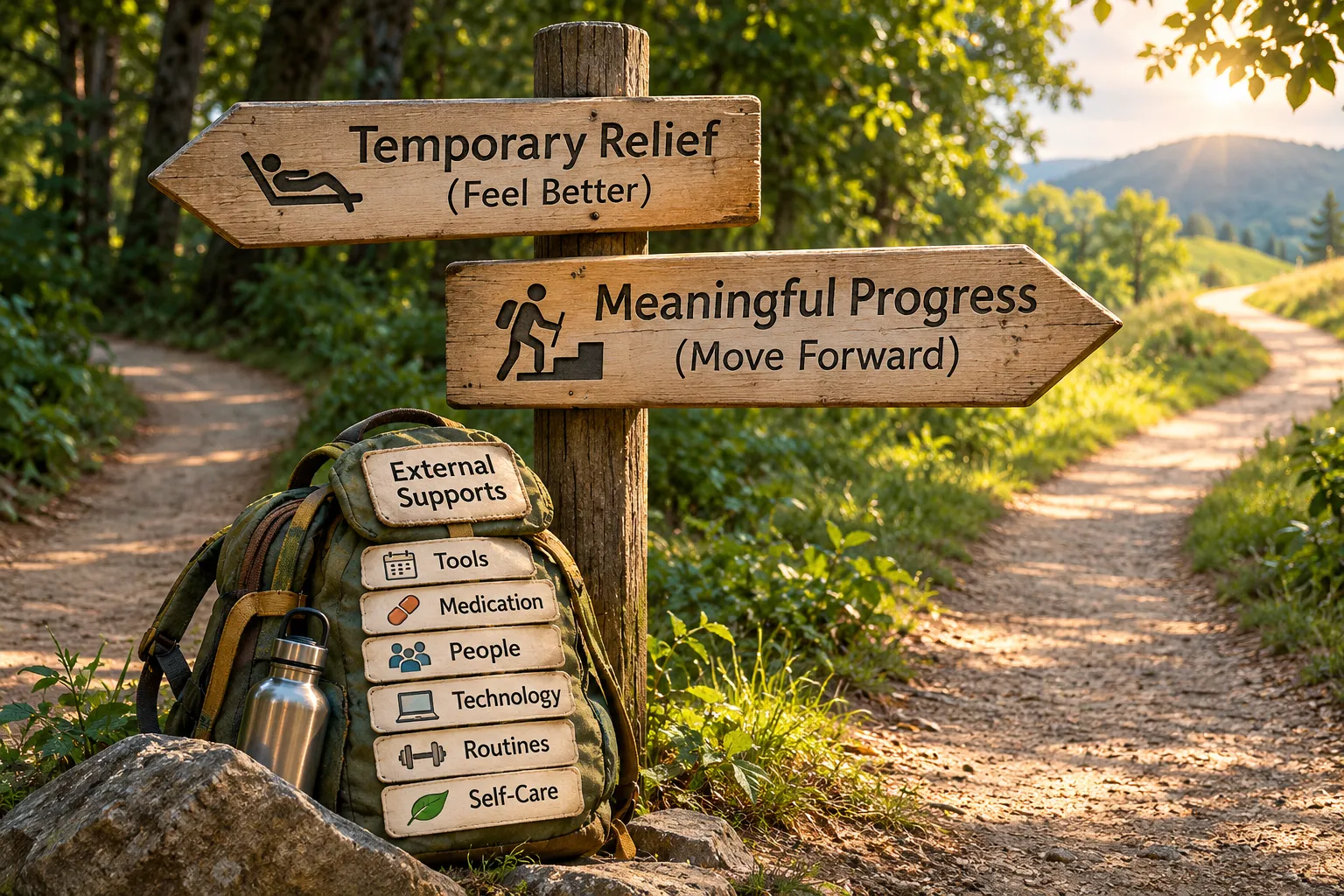
Rethinking self-regulation, external supports, and the gap between good intentions and reliable behavior
We all use things outside ourselves to help manage our lives.
We use calendars to remember appointments, medications to manage symptoms, friends to help us through difficult times, and technology to organize our responsibilities. We exercise, listen to music, watch television, meditate, and find all kinds of ways to manage our emotions.
Some of these things help us feel better. Some help us function better. Some do both.
But I've been thinking about a question: How do we know whether the things we rely on are actually helping us accomplish what we're trying to accomplish?
I'm particularly interested in this question because of what I call the intention–action gap: the distance between our good intentions and our ability to act on them consistently.
Most of us have good intentions. We want to take care of ourselves, maintain relationships, meet our responsibilities, and create lives worth living.
But wanting to do something and reliably doing it are different.
And sometimes the very things we use to help ourselves can make that gap smaller—or larger.
Feeling Better Isn't Always the Same as Functioning Better
Self-regulation is the process of monitoring and managing our attention, thoughts, emotions, and behavior to pursue goals and adapt to changing circumstances.
Sometimes we use external supports to help us do that.
Imagine someone who is overwhelmed by financial problems. Every time they think about their bills, they become anxious. So they turn to something that helps them relax.
And it works.
They feel better.
But the bills are still there. The financial problems haven't changed. And they haven't taken any action to address them.
Now, I don't think there's anything inherently wrong with wanting relief from emotional discomfort. Sometimes we need a break. Sometimes we need to rest. Sometimes feeling better is an important goal in itself.
But I wonder what happens when relief repeatedly replaces action.
What happens when we get better at escaping the discomfort tied to our problems without getting better at addressing them?
That's where I think an external support can become part of the intention–action gap rather than a bridge across it.
We Don't Have to Do Everything Ourselves
Now, there's an important counterargument to what I'm suggesting.
Why should we assume that successful self-regulation means developing the ability to do everything independently?
I don't think it does.
Consider someone with a physical disability who uses a wheelchair. The wheelchair may not restore their ability to walk, but it can help them get to work, visit friends, participate in community activities, and accomplish meaningful goals.
The wheelchair isn't preventing them from developing self-regulation. It's part of how they regulate their lives.
The same is true of someone who uses a calendar because they have difficulty remembering appointments, or someone who needs medication or another person's assistance to manage everyday responsibilities.
People have different abilities, different limitations, and different circumstances. Some limitations may never disappear.
And that's fine.
The goal isn't necessarily to become independent of external supports. The goal is to become more effective at using the resources available to us to live the lives we want to live.
In fact, recognizing that we need help, finding appropriate resources, and learning how to use them may be important self-regulation skills themselves.
So How Do We Know Whether Something Is Helping?
This is where I think curiosity becomes especially useful.
Rather than immediately deciding whether someone's coping strategy is good or bad, I want to understand what it's doing for them.
What problem are they trying to solve?
What does the support help them accomplish?
What happens after they use it?
Are they becoming more capable of doing the things they want to do? Are they maintaining their commitments? Are their relationships improving? Are they learning something that helps them approach future difficulties?
Or are they experiencing temporary relief while the problems they want to address remain unchanged—or become more difficult?
These aren't questions I would use to judge someone.
They're questions I would want to explore with them.
And the answers may be different for different people, even when they're using exactly the same external support.
Something that helps one person move forward might interfere with another person's progress.
The important thing is to remain curious about what actually happens.
Understanding Is Doing, and Doing Is Understanding
Another part of this interests me.
Suppose someone finds a strategy that helps them accomplish a goal. That's good. But what happens when their circumstances change?
Can they recognize why the strategy worked? Can they recognize when it stops working? Can they make adjustments or find additional help?
I think learning from what we do is part of becoming more effective at navigating the intention–action gap.
But I don't mean that everyone must be able to explain their behavior in sophisticated language. Sometimes understanding is practical. We demonstrate it through our actions, our adjustments, and our ability to recognize when something needs to change.
And sometimes we understand exactly what we need to do but still struggle to do it.
That's the intention–action gap.
Understanding doesn't automatically produce action, and action doesn't automatically produce understanding.
But the two can inform each other.
We try something. We observe what happens. We learn from the experience. And we make adjustments.
Sometimes we succeed. Sometimes we fail. Either experience can teach us something useful.
What About the Things We Can't Control?
There's another complication.
Sometimes people do everything reasonably within their power and still don't accomplish their goals.
They may face discrimination, poverty, inaccessible services, inadequate transportation, or circumstances that simply aren't under their control.
We have to be careful not to interpret every unsuccessful outcome as a failure of self-regulation.
A person may be doing an excellent job of organizing their resources and responding to challenges while living in an environment that makes success extraordinarily difficult.
That's why I think we have to look at both the person's behavior and the conditions under which that behavior occurs.
The intention–action gap doesn't exist in a vacuum.
Sometimes the problem isn't that someone lacks the skills to move forward. Sometimes the environment places obstacles in their way that no amount of personal discipline can eliminate.
And sometimes effective self-regulation involves recognizing those obstacles, seeking help, changing the environment when possible, or reconsidering what can reasonably be accomplished.
The Real Question
I've become less interested in whether a person uses an external support and more interested in what happens as a result.
Does it help them accomplish something meaningful?
Does it make their behavior more reliable?
Does it help them respond to changing circumstances?
Does it create new difficulties that outweigh its benefits?
And perhaps most importantly, are they learning something about themselves, their circumstances, and the resources they need?
I don't think we have to eliminate the intention–action gap. There will always be some distance between what we intend to do and what we actually accomplish.
Life changes. We change. Our abilities change. Our circumstances change.
The challenge is learning how to navigate that distance more effectively.
Sometimes that means developing a new skill. Sometimes it means asking for help. Sometimes it means using a tool we'll need for the rest of our lives.
And sometimes it means taking a closer look at something we've been relying on and asking whether it's actually helping us move forward.
The question isn't simply, "Does this make me feel better?"
It's also, "What does this help me do?"
And I think that's a question worth asking ourselves and one another, with curiosity rather than judgment.
Individual Relationship Therapy
 GC
Gerald B. Chambers, LMFT #100367
Licensed Marriage and Family Therapist specializing in addiction, domestic violence, and relationships. Serving California clients online.
About Gerald →