Lifestyle
Inside the Box: When Possibilities Become a Problem
November 25, 2026
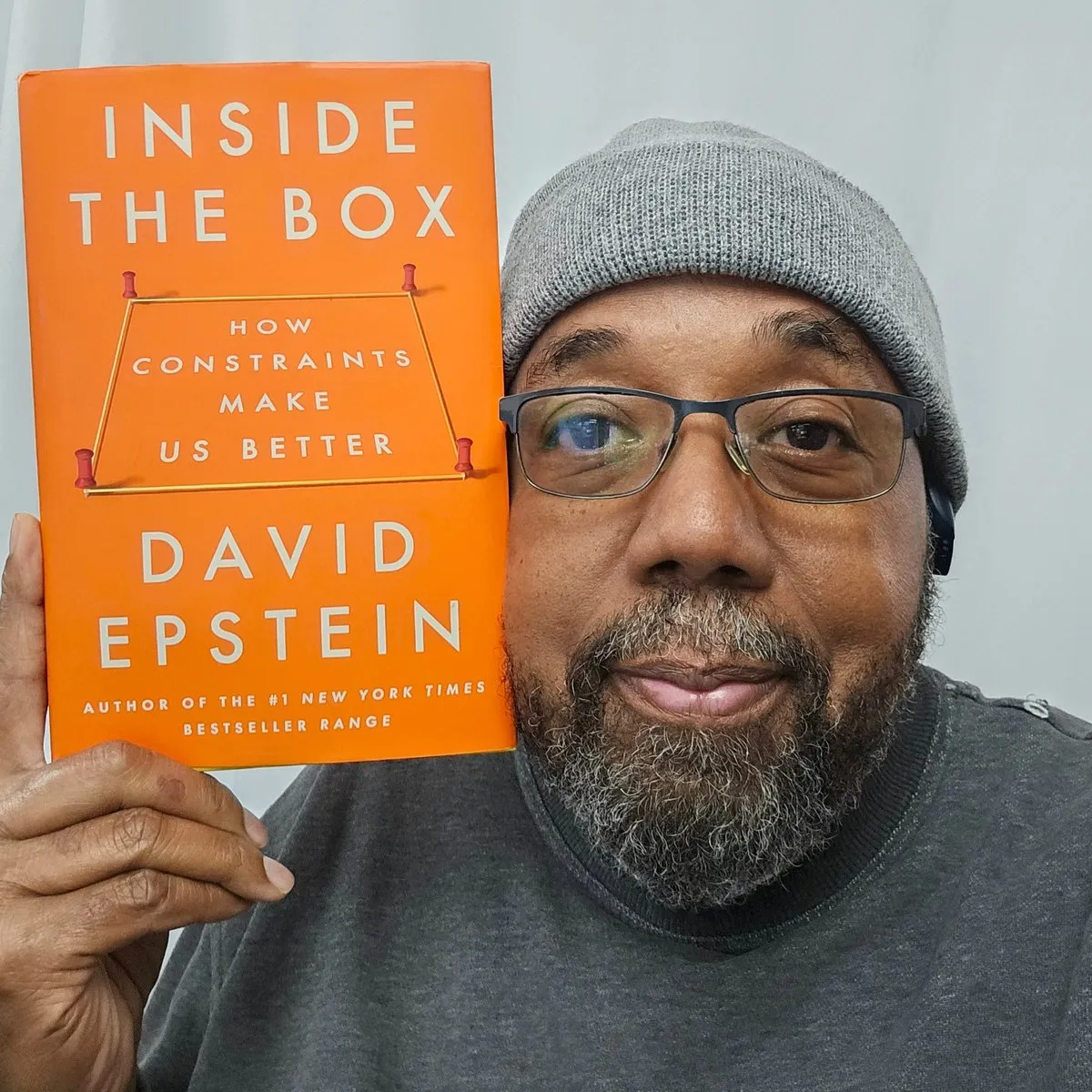
A book review of Inside the Box by David Epstein
Every once in a while, I read a book that makes me want to put it down, not because I'm bored, but because it has given me something new to think about. David Epstein's Inside the Box is one of those books.
It touched on so many things that interest me: where ideas come from, how creativity develops, the usefulness of constraints, and how we can make our lives more manageable without making them less interesting.
I thoroughly enjoyed this book.
The General Magic Problem
One of the most compelling stories for me was that of General Magic, an early Silicon Valley technology company.
General Magic had extraordinary talent, financial resources, industry support, and an ambitious vision of the future. It had many of the things we ordinarily associate with success.
Yet one problem was the difficulty of imposing limits. So many good ideas complicated the company's efforts to complete and deliver its products.
Having another good idea could mean pushing back a deadline. The possibilities kept expanding, making execution more difficult.
I call this the General Magic problem.
What fascinates me about this story is that we may be experiencing a similar problem today with artificial intelligence.
AI lets us explore ideas, develop projects, acquire information, and imagine possibilities at an extraordinary rate. Things that once seemed beyond our capabilities are suddenly within reach.
But who will impose the limits?
AI can help me figure out how to do a hundred different things, but that doesn't mean I should attempt to do a hundred different things.
Without consciously imposed constraints, AI could actually widen the gap between my intentions and my actions. I could become increasingly capable of imagining what I might do while becoming less effective at completing what I have already decided to do.
More possibilities do not necessarily make us more effective.
The General Magic Problem in Recovery
I have observed something similar among people who are new to Twelve Step recovery.
Understandably enthusiastic about the possibilities of a new life, some people begin pursuing recovery in multiple directions. They attend meetings in several fellowships, take on numerous commitments, accumulate recovery literature, and try to address every aspect of their lives at once.
Their intentions may be entirely worthwhile. Their enthusiasm may be genuine. However, they can become a mile wide and an inch deep.
In their efforts to do everything, they may not devote enough time and attention to building the foundation needed to sustain their recovery.
Attending meetings is important, but so is developing meaningful relationships, working the steps, practicing spiritual principles, reflecting on one's behavior, and learning how to apply what one is discovering to everyday life.
These things take time.
An important observation in Twelve Step literature is that social acceptability is not recovery.
A person can learn the language of recovery, become socially accepted within a recovery community, and participate in numerous activities without necessarily experiencing the bigger changes that recovery makes possible.
The issue is not whether attending multiple fellowships is inherently problematic. The issue is whether the breadth of our activities comes at the expense of the depth of our engagement.
Perhaps one of the most useful things a person entering recovery can learn is how to set limits, build a foundation, and let that foundation support the gradual expansion of their life.
More recovery-related activity does not necessarily mean deeper recovery.
Sometimes, doing fewer things more thoroughly may be precisely what makes sustainable recovery possible.
Ideas Are Like Seeds in a Garden
Another fascinating aspect of the book was its exploration of where ideas come from and how they develop.
Throughout history, people in different places have arrived at remarkably similar ideas at approximately the same time without collaborating or even knowing about one another.
I find this fascinating because it challenges the notion that ideas are exclusively the products of individual genius. Perhaps we should pay more attention to the conditions under which ideas emerge.
I like to think of ideas as seeds in a garden. We plant more than one seed because we don't know which ones will germinate, which ones will flourish, or what might develop under the right conditions.
Reading, having conversations, experimenting, and exposing ourselves to different experiences are ways of planting seeds.
I didn't read Epstein's book specifically to learn more about the intention–action gap. Nevertheless, several ideas in the book connected with questions I have already been exploring.
But an important distinction exists between cultivating ideas and pursuing them.
A gardener must also understand the importance of thinning, pruning, and providing sufficient room for things to grow. Planting more seeds does not guarantee a more productive garden.
I can entertain many ideas without committing myself to acting on all of them.
Not every good idea needs to become a project.
Haiku as a Way of Life
Perhaps one of my favorite ideas from the book was the notion of haiku as a way of life.
The constraints of a haiku do not eliminate creativity. They provide a structure within which creativity can flourish.
What would happen if we applied that principle to other areas of our lives?
What if we deliberately made our decisions smaller, limited the number of projects we pursued, and became more selective about our commitments?
We often associate freedom with having more choices. However, having fewer choices may sometimes give us greater freedom to act.
A smaller project might be more enjoyable. A clearly defined intention might be easier to pursue. Limiting our commitments might make us more reliable.
Perhaps the richness of life has less to do with how many things we can do and more to do with the quality of our engagement with the things we choose to do.
The Intention–Action Gap
As someone who has been exploring the gap between good intentions and reliable behavior, I found several ideas in Epstein's book worth investigating.
I have spent considerable time thinking about the skills necessary to translate intentions into actions. But what about the process of limiting our intentions in the first place?
Sometimes, we make execution unnecessarily difficult by pursuing too many worthwhile intentions at once.
The problem isn't necessarily that our intentions are bad. The problem may be that we have too many good ones.
Before asking ourselves how we can become more productive, perhaps we should ask:
Is this a worthwhile intention?
How many other intentions am I already pursuing?
What am I willing to set aside?
Can I make this intention smaller without sacrificing its value?
Am I sacrificing depth for breadth?
What would constitute enough?
These questions become particularly important as artificial intelligence expands our capabilities.
We may need to become as skilled at limiting our intentions as we are at generating them.
Learning to Live Within Limits
One of the things I enjoy most about reading is discovering connections between someone else's ideas and the questions I am already asking.
David Epstein has given me several new ways to think about creativity, freedom, decision-making, recovery, and reliable behavior.
His book has also encouraged me to reconsider my relationship with limitations.
I don't want to stop generating ideas. I don't want to become less curious or less creative. I want to continue planting seeds, exploring possibilities, and discovering new things.
But I also want to enjoy my life, honor my commitments, deepen my understanding, and finish some of the things I start.
That requires limits.
I highly recommend Inside the Box to anyone interested in creativity, personal growth, decision-making, recovery, or simply learning how to live better in a world of expanding possibilities.
Perhaps one of the most important skills we can develop in the age of artificial intelligence is knowing what not to do.
I don't necessarily want a bigger life. I want a deeper one.
 GC
Gerald B. Chambers, LMFT #100367
Licensed Marriage and Family Therapist specializing in addiction, domestic violence, and relationships. Serving California clients online.
About Gerald →